






 Spell
 Continuous
Card of Safe Return
View:
6156
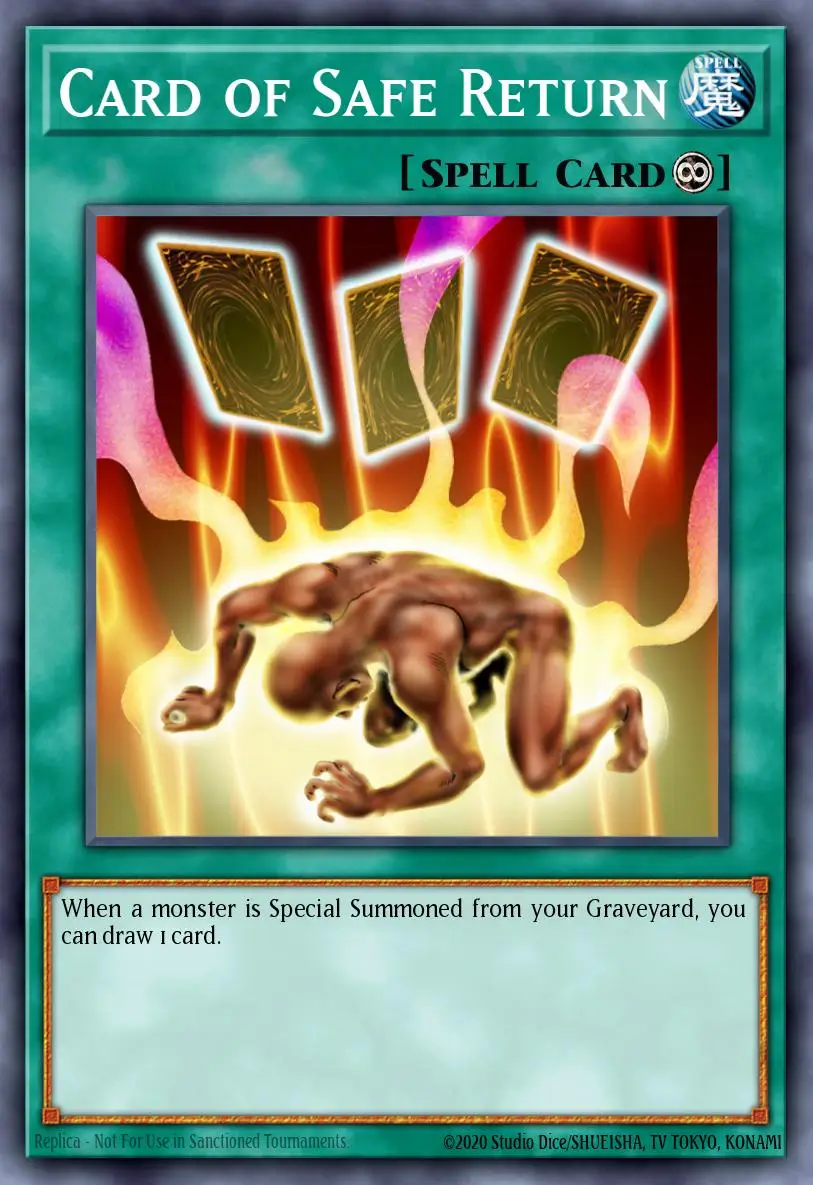
When a monster is Special Summoned from your Graveyard, you can draw 1 card.


Card of Safe Return — Power Evaluation
Final Score: 47 ± 8 · Confidence: Medium
- Intrinsic: 49 · Deck: 46 · Meta: provisional
- Primary role: Recovery/Recursion · Secondary: Utility
Why it scores here
Card of Safe Return converts Graveyard Special Summons into card draw, so its value depends on the deck already producing GY Special Summons. It is a generic, archetype-agnostic engine piece that appears in 14 sampled decks across 8 archetypes, and it is cheap to run at about two copies per deck. The score stays moderate because there are no combo boards or guides to show what it actually converts into, and its legal_copies are reported as 0 in every format, which contradicts the deck usage and lowers the Deck score by 2. The rubric does not reward its frequency in decks: it is a staple-level draw trigger, not a boss or a board-breaker.
Axis scores
| Axis | Score | Evidence |
|---|---|---|
| Accessibility | 45 | It is a continuous spell with no searcher or summon route in the evidence, and it appears in 14 decks at about 1.9 copies each, so it is live in hand in some shells (inferred from deck counts; no as_starter or as_searched data) (observed). |
| Combo & Conversion | 30 | Its text only draws 1 card per Graveyard Special Summon and does nothing on its own, and there are no recorded combo boards to confirm a payoff chain (verified from text; no combo data). |
| Resource Economy | 60 | Each Graveyard Special Summon can draw a card, so it can generate repeated card advantage over a turn (verified from text; magnitude inferred). |
| Effect & Interaction | 5 | It has no negation, removal, or hand-trap effect and provides no opponent interaction (verified from text). |
| Material Utility | 5 | It is a spell card and cannot be used as material or a name/level provider (verified from card type). |
| Resilience & Flexibility | 45 | It stays on the field across turns, but it can be destroyed by spell removal and has no redundancy beyond the copies run (inferred from frame and text). |
| Deck-Building Efficiency | 80 | It is a single-copy-cheap continuous spell with no garnet, lock, or restriction, and it is easy to splash or run 1 to 3 copies (inferred from decks_evidence copy distribution). |
Calculation
Weight profile: 0.7 Recovery/Recursion + 0.3 Utility. Intrinsic ≈ 49, Deck ≈ 46, Meta = provisional. Modifiers: Illegal-format penalty (legal_copies = 0 everywhere) (-2). Final formula: 0.40*Intrinsic + 0.60*Deck
Strengths
- Turns each Graveyard Special Summon into a card, so it rewards decks that already have GY recursion
- Cheap and easy to run, with 1 to 3 copies per deck in the sample
- Archetype-agnostic text that fits across 8 sampled archetypes
Weaknesses
- Does nothing without Graveyard Special Summons already happening
- No searcher or direct access route in the evidence
- No interaction, negation, or material value
- Legal copy count in the evidence contradicts its deck usage
Counters / choke points
- Spell removal or destruction effects on the continuous spell
- Graveyard-hate effects that stop Special Summons from the Graveyard
Best use
Graveyard Special Summon draw engine in decks that already recur monsters from the Graveyard. Decks: Dark World, Book Of, Greed, Mayakashi, Paleozoic.
Evidence & gaps
- Verified: Card text: when a monster is Special Summoned from your Graveyard, you can draw 1 card; Card type: Continuous Spell with no archetype and no level, ATK, or DEF; legal_copies reported as 0 in TCG, OCG and MasterDuel
- Observed: Appears in 14 sampled decks (decks_running_main 14, decks_running_side 0); Spans 8 distinct archetypes and 4 gameplay types; Average 1.93 copies per deck, max 3; Top partner Pot of Avarice in 64.3% of its decks
- Inferred: Draw value scales with how often the deck produces Graveyard Special Summons; Archetype-agnostic text gives high portability across homes; Spell removal is the main realistic way to stop its ongoing draw
- Data gaps: no combos supplied; combo conversion is text-only inference no guides supplied no usage statistics (StatisticsCard); archetype inclusion inferred from the deck sample only legal_copies is 0 in every format while 14 decks run the card; needs a banlist check no starter-count data, so DeckResilience is estimated from archetype spread and copy distribution